


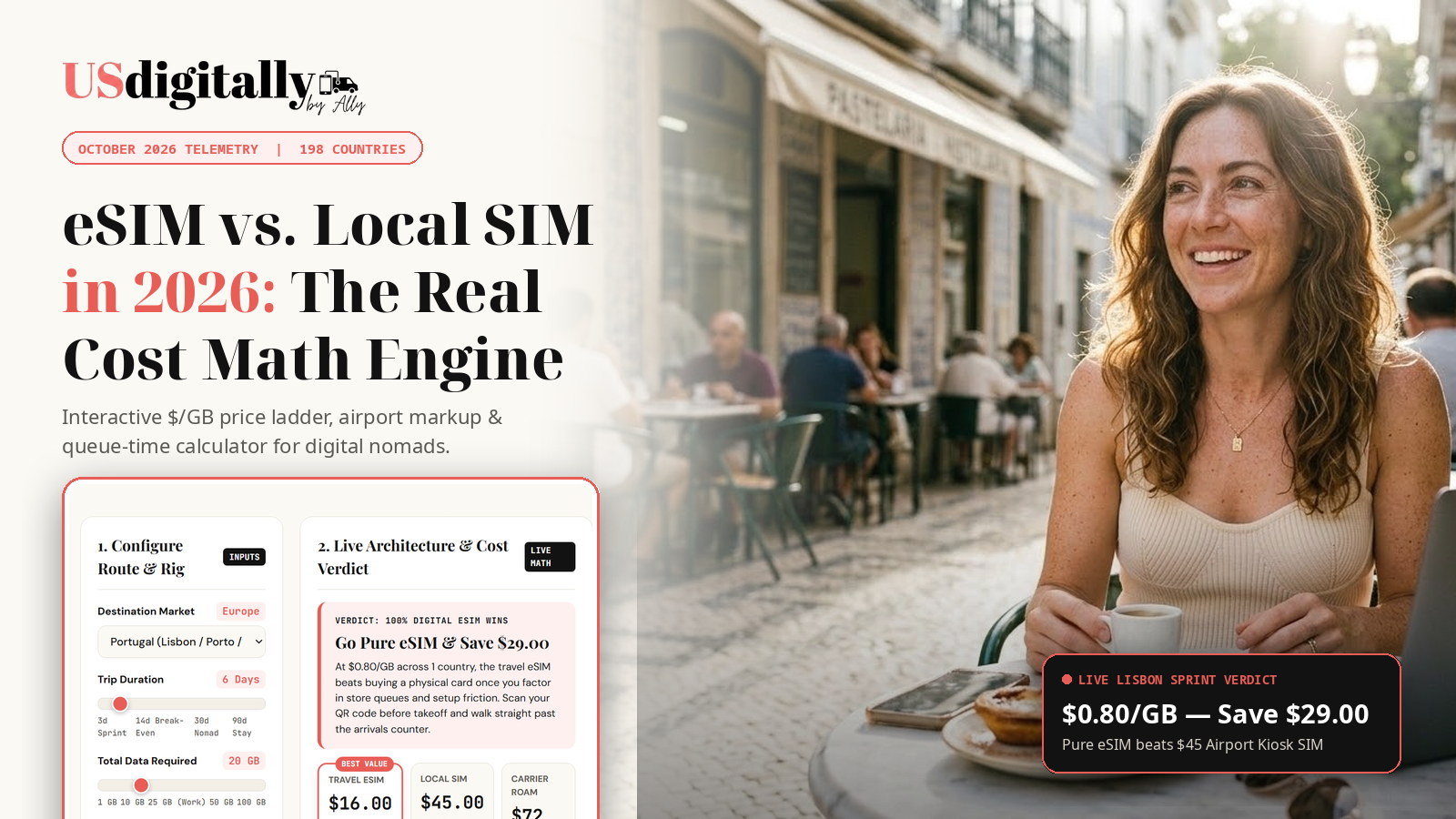
I debug API funnels on a glass whiteboard, watch a dual-screen terminal late at night, and answer client Slacks between two pastéis de nata in Lisbon. One rule keeps the whole nomad stack honest: friction costs more than bandwidth.
The calculator below puts a number on that. Move the sliders, load a real itinerary, and see whether a travel eSIM, a local carrier card, or a hybrid dual-SIM setup comes out cheapest for your trip.
Why sticker-price connectivity is a trap
Most travel blogs compare eSIMs and physical SIMs on the sticker price of a 30-day bundle. That number hides the parts that decide your real cost: how fast the price per gigabyte falls on bulk tiers, how hard airport kiosks mark up tourist packages, whether your traffic is quietly routed through a foreign IP hub, and what an hour of your time is worth in a carrier queue.
If you want the full method behind these figures, start with our guide to eSIM vs Local SIM in 2026: The Real Cost Math, then run your own numbers here.
What the presets and the 14-day break-even tell you
- Quick-switch presets. Four buttons at the top load real itineraries: Lisbon 7d Sprint, Bangkok 50GB Promo, Da Nang 30d Nomad Base, and Euro 3-Country Rail Hop. Tap one and the sliders snap to that scenario.
- The 14-day window. For trips under two weeks, or any route crossing two or more borders, travel eSIMs win once you value your queue time above $25 an hour.
- The one-phone, two-plan rig. Parking your laptop in a low-cost data market for a month? Run a $1.50–$2.20 landing eSIM to clear customs and reach your ride, then pick up an unthrottled local 5G SIM at an official city shop on day two. Vietnam runs around $0.20/GB, India near $0.10/GB, Bali about $0.30/GB.
Tips for digital nomads and remote engineers
- Check your IP gateway before Monday standup. If you depend on strict corporate VPNs, production databases, or banking portals, toggle the "Strict Local IP Required" box. Many Asian and European eSIMs route traffic through Singapore, Hong Kong, or Frankfurt hubs, which can trigger automated security lockouts.
- Keep a failover line dormant. Even when a local physical SIM handles heavy tethering, I keep a $5 pay-as-you-go eSIM asleep in the second slot. When café Wi-Fi dies mid-deployment, switching carriers takes two taps.
Test your own itinerary
The break-even line matters more than brand loyalty. Run your next trip through the calculator, then drop your destination and your $/GB result in the comments. I want to see where the math landed: a travel eSIM, a local carrier card, or the dual-SIM hybrid.
Interactive Price-Per-Gigabyte & Workflow Cost Engine. Compare bulk eSIM ladders, airport kiosk markups, and your personal queue time cost in real time.
