


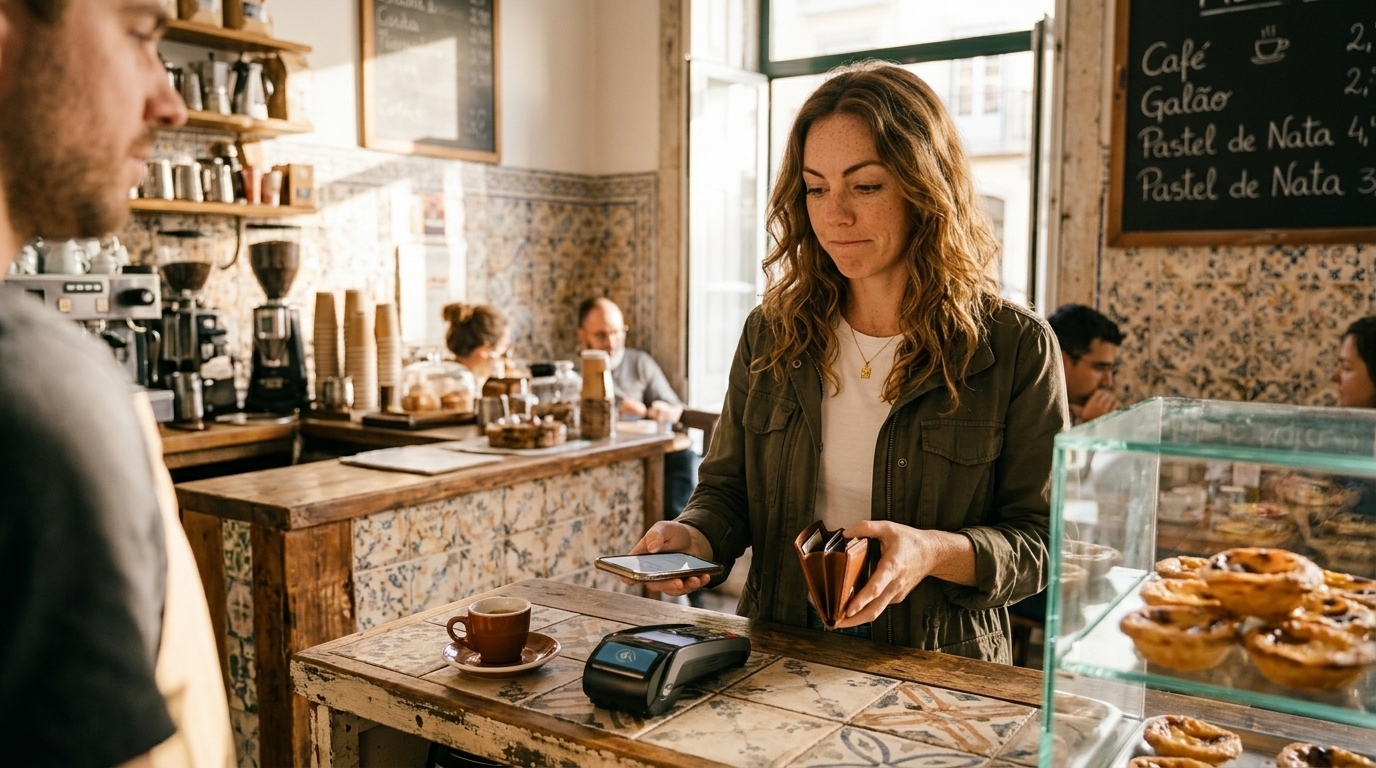
At 1:40 on a Tuesday, the pastelaria on Rua da Escola Politécnica had one free table, and I took it with the smugness of a man who works from cafés for a living. Bica, the quiche with leek in it, eleven euros forty. The waiter was about nineteen and had already decided to like me.
I tapped the card. The terminal went red. He tapped his side of it, that small gesture of professional optimism, and I pressed the card flat against the glass for longer than any card has ever needed. Red again. Third go, and the machine made the noise a machine makes when it is embarrassed for you.
“Maybe the internet,” he said, in careful English, smiling with a patience that should be against the law.
Maybe the internet. I opened the app to check a balance I already knew was healthy, enough for a hundred quiches and the train to Coimbra. The app spun. Then white. Then a login screen asking for a code sent to a number I abandoned in 2022.
I got back into that account eight hours later. By then I had borrowed twenty euros from a Canadian renting the room above mine, missed a call with a client I had been preening about all week, and walked home in the rain because I no longer trusted the metro app either. The card was fine. Genuinely fine. The thing behind the card was also fine, technically, in the way a bridge missing one cable is technically standing.
Two apps, one afternoon
For two years I had a spreadsheet comparing Wise and Revolut the way other people compare football teams. Conversion spread, weekend markup, ATM caps. The numbers are real: both add roughly one percent on major pairs when the FX market is shut, both give you a couple of hundred a month in free withdrawals before the meter starts, and the fee gap on a Tuesday transfer is small enough that I have spent more on coffee arguing about it.
Deposit protection is the part worth reading twice, and it is where the two of them genuinely differ. In the UK, the £85,000 FSCS shield sits behind authorised banks. In Australia, the Financial Claims Scheme covers deposits with ADIs. Wise and Revolut hold customer money under e-money and client-money rules, which is a real safeguard and a different promise, and the exact position shifts with licences, entities and whichever country you happen to be standing in. Check it before you need it. Mine was not the paragraph I had memorised.
Money you cannot reach is not money. It is a rumour with a nice interface.
Here is what should worry you. A writer I know in Melbourne had the same lunch, in the same week, on the other side of the planet: card refused three times, app refusing to load, then refusing to log in. Two companies, two regulatory homes, two sets of fees, and one shared afternoon of nothing working. The rails underneath are the same rails. The cloud is the same cloud. The comparison table measures the difference between two things that failed together.
The backup I build before I need it
So I stopped optimising and started separating. Four jobs, four providers, no single app holding two of them. Day-to-day spending lives on one card. Salary and savings land in an actual bank, the boring kind with a phone number and a branch I have never visited. Investments sit with a broker that has never heard of the other three. Records live in a folder that works offline, because the one thing I could not do for eight hours was prove I existed.
That last part is the cheapest fix and the one I resisted longest. A photograph of my passport, my account numbers, my tax file number or national insurance number, and the recovery codes, all in a folder on the phone that needs no signal. Plus forty euros folded inside the paperback I am reading, which has now saved me twice, in Lisbon and in Palermo.
What the counter taught me
The patient smile is the expensive part. Not the decline, not the weekend markup. It is the small social debt of standing there while a stranger waits for you to be a functioning adult and a queue builds behind you and you say “one moment” in a language you are still renting.
Fees are worth about forty euros a year to me now. A second card from a different issuer is worth an afternoon, a missed call and a story I would rather not tell again. Choose the dull arrangement. Two issuers, one bank with a real licence, cash in the book, codes you can read without wifi. Then go back for the quiche.
